Comparison · 5 picks
Best Dog Water Bottle for Travel UK 2026: 5 Top Picks
Affiliate disclosure: we may earn a commission when you buy through links on this page, at no extra cost to you. Our verdicts are our own and are not influenced by compensation. As an Amazon Associate I earn from qualifying purchases.
What to Look for in a Dog Travel Water Bottle
The four things that actually matter
Most dog travel bottles do the same basic job, but small design choices add up over a year of daily use. The four things to weigh up:
1. Capacity. A 350-500ml bottle is enough for short walks and small breeds. For day hikes, summer travel, or large breeds (Labradors, German Shepherds, Goldens), you want 700ml or more - or you'll find yourself rationing.
2. The drinking interface. Two designs dominate the UK market: integrated lid-bowls that flip into a trough (the Highwave AutoDogMug pattern) and clip-on silicone bowls separate from the bottle. Lid-bowls are slicker for one-handed use; clip-ons are easier to clean and let multiple dogs drink at once.
3. Leak-proofing. A leaky bottle in a rucksack ruins your day. Look for a positive-locking valve or push-button release rather than a simple flip-cap - and ideally a lifetime guarantee that covers leaks (Ruffwear and Highwave both offer this).
4. Materials. BPA-free food-grade plastic is the norm; stainless-steel options (PupFlask, some Lesotc models) keep water cooler for longer but weigh more. Silicone bowls are fine and dishwasher-safe; rubber bowls hold odours over time.
At a glance
All 5 options side by side.
| Highwave AutoDogMug | Ruffwear Quencher Cinch Top | Lesotc Dog Water Bottle | PupFlask Vacuum-Insulated Bottle | Foldable Silicone Bowl + Your Own Bottle | |
|---|---|---|---|---|---|
| Price | £25 | £29.65 | £13 | £28 | £5 |
| Best for | Best all-rounder for single-dog households. | Best lightweight option for hikers who already carry a hydration pack. | Best budget pick. | Best for hot weather and long road trips. | Best minimalist pick - and the right backup even if you buy a dedicated bottle. |
| Review | Read review → | Read review → | Read review → | Read review → | Read review → |
| Buy |
The picks in detail
Highwave AutoDogMug
Bottom line. Best all-rounder for single-dog households. The decade-old design genuinely beats every imitator on one-handed use - squeeze, dog drinks, tilt back, leftover water siphons home. Pick the 700ml unless you have a toy breed.
Pros
- Squeeze-and-release siphon design siphons unused water back into the reservoir
- Genuine one-handed operation - the only bottle here you can use while holding the lead
- 550ml and 700ml sizes; BPA-free; dishwasher-safe top rack
- Owner reports of 5+ years daily use; Highwave honours warranty replacements
Cons
- Lid-bowl only fits one dog at a time - awkward for two-dog walks
- Plastic body warms in summer - water reaches bath temperature on hot days
- Mid-tier price for a single-function bottle
Ruffwear Quencher Cinch Top
Bottom line. Best lightweight option for hikers who already carry a hydration pack. Splitting your own water into the Quencher when needed is much more efficient than carrying a separate dedicated dog bottle - and the wide bowl is friendlier for multi-dog households.
Pros
- Packs flat to about the size of a fist - 65g empty
- Wide bowl opening lets two dogs share at once
- DWR-coated nylon shares construction with the rest of Ruffwear's pack range
- Three sizes (the medium handles 1.5L, large takes 2.5L)
Cons
- Bowl only - you carry water in a separate bottle or hydration bladder
- Water-resistant lining isn't designed for long-term water storage
- Hand-wash only; dishwasher heat degrades the DWR coating
Lesotc Dog Water Bottle
Bottom line. Best budget pick. Genuinely good-enough for a first dog water bottle or a backup for the car - the transit lock is a small but real improvement on the Highwave pattern at half the price. Replace it every 12 to 24 months and you're still ahead on cost.
Pros
- Under £15 - the entry-level Highwave-style integrated lid-bowl
- One-button transit lock seals the lid against rucksack chaos
- 350ml and 550ml capacity options - 350ml is handy for small breeds
- Replaceable silicone seals extend life when they eventually wear out
Cons
- Squeeze-back siphon is less smooth than Highwave - some spillage
- Long-term durability not as proven - typically 1 to 2 years of heavy use
- Capacity caps at 550ml - not enough for full-day hikes with a medium-or-larger dog
PupFlask Vacuum-Insulated Bottle
Bottom line. Best for hot weather and long road trips. On a 30°C summer walk, the difference between insulated water and bath-warm plastic-bottle water is a dog who drinks willingly versus one who turns up their nose. Worth the weight penalty if you live in a flat with poor air conditioning, regularly travel in summer, or own a brachycephalic breed.
Pros
- Double-walled stainless steel keeps water cold for 6 to 8 hours
- Capacity is generous - 740ml standard, 1.4L in the large
- Press-button release pours into the integrated trough lid
- Drop-tested durable - kicks across a beach without damage
Cons
- ~380g empty - roughly twice the weight of the Highwave
- Hand-washing recommended - dishwasher heat can damage the vacuum seal over time
- Higher price than plastic bottles
Foldable Silicone Bowl + Your Own Bottle
Bottom line. Best minimalist pick - and the right backup even if you buy a dedicated bottle. Lives permanently in the car or rucksack, doesn't go off, doesn't break. Pairs especially well with a vehicle-based travel pattern where you can rest the bowl on a boot floor or picnic blanket.
Pros
- Lightest, cheapest option - silicone bowls fold to ~1cm thick
- Food-grade, dishwasher-safe, and outlasts pretty much every dedicated bottle
- Carabiner clip mounts to a bag or belt loop
- Works with whatever reusable water bottle you already carry
Cons
- Two-handed - one hand holds the bowl, one hand pours
- Awkward on a windy clifftop walk with a lead in your other hand
- Not a solution for one-handed motorway-services water breaks
How to Choose
Quick decision framework
For most people, buy the Highwave AutoDogMug 700ml. It's the all-rounder that does everything well, has decade-long durability evidence, and works one-handed.
Buy the Ruffwear Quencher if you already hike with a hydration pack and want to add minimal weight.
Buy the Lesotc if you want a good-enough bottle without spending much.
Buy the PupFlask if you live in a flat with poor air conditioning, regularly travel in summer, or own a brachycephalic breed.
Buy a silicone bowl if you only need water at the destination, not on the move.
Hydration on the Move: A Few Practical Tips
Habits that prevent dehydration
Offer water more often than you think. Dogs don't always show thirst the way humans do. On a hot day, offer water every 30-45 minutes regardless of whether your dog has stopped to drink unprompted.
Watch for early dehydration signs. Sticky gums, panting that doesn't ease in the shade, and skin that doesn't snap back when gently pinched on the scruff are all early warnings. If you see these, find shade, stop walking, and offer water.
Use the same bottle every time. Dogs are fussier about water than they let on - a bottle that's been used for old water, sat in a hot car, or washed with strong-smelling detergent can put them off drinking. Rinse with plain water after each walk, deep-clean weekly with hot water and a mild dishwasher tab.
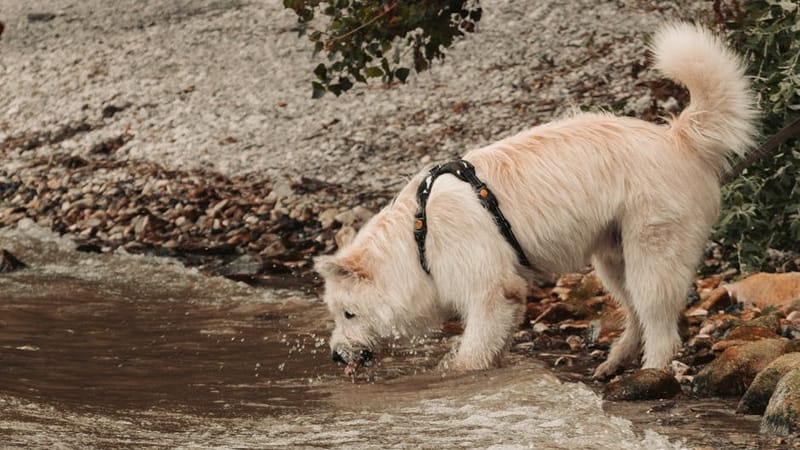
Don't let them drink from puddles, ponds, or seawater. UK puddles routinely contain Leptospira bacteria; standing pond water can host blue-green algae (often fatal); seawater causes salt poisoning. A bottle gives you somewhere clean to point them when they're thirsty.
Plan refills. A 700ml bottle is enough for a 2-3 hour walk for most dogs. For longer outings, plan a refill point - a public tap, a pub garden, or a stream you trust (running water is generally safer than standing water, but boil if uncertain).
Water Volume Per Dog: A Practical Scale
How much your dog needs by weight and conditions
Hydration needs scale roughly linearly with body weight, but the multiplier shifts with conditions. A useful baseline is around 50ml of water per kilogram of body weight per day at rest. For a 10kg cocker spaniel, that's about 500ml; for a 25kg labrador, about 1.25 litres. On hot days, during active hikes, or after motorway service stops where dogs pant from arousal not heat, multiply that baseline by 1.5 to 2.
The practical implication for a travel water bottle: a 500ml bottle covers a small dog for a full day, a working dog for half a day, and a large dog for one to two hour-long stops. Carry a second bottle for any journey over four hours.
Quick reference for breeds you'll see on the M5 or M6 service stops:
- Yorkshire terrier (4 to 6kg): 200ml to 400ml per day baseline
- Cocker spaniel (10 to 15kg): 500ml to 750ml per day baseline
- Labrador (25 to 35kg): 1.25 to 1.75 litres per day baseline
- Newfoundland (50 to 70kg): 2.5 to 3.5 litres per day baseline
Carry roughly double these volumes when the day involves a long walk, summer travel, or a service-station break that's longer than an hour.
Cold Weather and Frozen Bottles
Why one bottle works in February and another doesn't
What are the most-asked questions?
Q01Can I just use a regular water bottle?
Q02How often should I replace my dog's water bottle?
Q03What about flavoured water or electrolytes for dogs?
Q04Can I freeze water in these bottles?
Q05My dog won't drink from the bottle. What can I do?
Q06Are these bottles dishwasher-safe?
Ready for the trip itself?
Once your hydration setup is sorted, the bigger question is where to go. Our destination guides cover dog-friendly cottages, beaches, and pubs across the UK.