Comparison · 4 picks
Best Automatic Litter Boxes UK 2026: 4 Compared
Affiliate disclosure: we may earn a commission when you buy through links on this page, at no extra cost to you. Our verdicts are our own and are not influenced by compensation. As an Amazon Associate I earn from qualifying purchases.
An automatic litter box scoops itself, so you empty a sealed drawer every few days instead of scooping twice a day. For busy owners and multi-cat homes the convenience is real, but these are expensive machines with genuine differences in safety, capacity and how readily a cat will use them. This guide compares four UK-buyable models from budget to flagship.
Which automatic litter box should I buy?
- You want the best and have the budget - the Litter-Robot 4. The most reliable, best for multiple cats, with a 90-day home trial.
- You want most of that for less - the PETKIT Pura Max 2, an enclosed smart box at roughly half the price.
- Your cat is nervous of enclosed boxes - the open-top Neakasa M1 Plus.
- You want the cheapest, simplest option for one cat - the PetSafe ScoopFree.
Are automatic litter boxes worth it?
For the right household, yes. If you are out for long hours, have limited time, or run a multi-cat home where a manual tray needs scooping several times a day, an automatic box removes a real daily chore and keeps the tray consistently clean, which cats prefer. Many also track litter-box visits through an app, giving an early warning of health changes such as a cat visiting far more or less than usual.
They are not for everyone. They cost far more than a simple tray, they need mains power and clumping (or crystal) litter, and a nervous cat can refuse a noisy, moving box. If you have one relaxed cat and plenty of time to scoop, a good manual tray does the job for a fraction of the price.
Are automatic litter boxes safe for cats?
Modern units are, provided you choose one with proper safety sensors and set it up correctly. Every box here uses weight or motion sensors to detect a cat and pause or delay the cleaning cycle, and models like the PETKIT carry multiple redundant sensors. The key rules: buy a current model with cat-detection safety features rather than a cheap unbranded box, keep it on a level surface, and supervise the first few uses so you know your cat is comfortable. Very small kittens and elderly or frail cats are better kept on a manual tray.
At a glance
All 4 options side by side.
 Litter-Robot 4 Litter-Robot 4 |  PETKIT Pura Max 2 PETKIT Pura Max 2 | 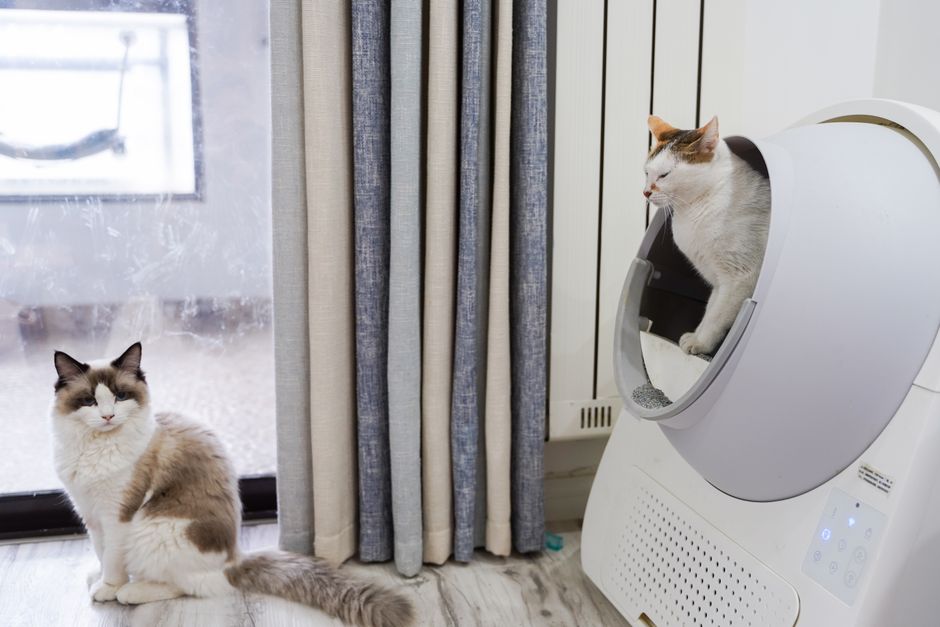 Neakasa M1 Plus Neakasa M1 Plus |  PetSafe ScoopFree (2nd Generation) PetSafe ScoopFree (2nd Generation) | |
|---|---|---|---|---|
| Price | See price | See price | See price | See price |
| Best for | The best overall, if you can justify the price. | The best value. | The best open-top option. | The simplest and cheapest way in. |
| Review | Read review → | Read review → | Read review → | Read review → |
| Buy |
The picks in detail
Whisker Litter-Robot 4
Bottom line. The best overall, if you can justify the price. The rotating globe sifts after every use, the app tracks each cat's visits and weight, and it genuinely copes with several cats. You pay a lot, and it is sold direct rather than on Amazon, but nothing else here is as polished.
Pros
- Best-in-class sifting and odour control
- Handles multiple cats comfortably
- Detailed app health tracking and 90-day trial
Cons
- By far the most expensive here
- Large footprint; sold direct rather than on Amazon UK
More buying options (1)
- Litter-Robot UK Check price View deal →
PETKIT Pura Max 2
Bottom line. The best value. It brings enclosed self-cleaning, a large capacity, app control and eleven safety sensors at roughly half the flagship's price. Some cats need coaxing into the hooded design, but for most multi-cat homes it is the smart-money pick.
Pros
- Premium features at a mid-range price
- Extra-large capacity suits multiple cats
- Strong odour control and safety sensors
Cons
- Enclosed design not every cat likes at first
- App setup can be fiddly
Neakasa M1 Plus
Bottom line. The best open-top option. With no hood or tunnel, nervous cats accept it far more readily than enclosed boxes, and it still has app tracking and a large capacity. The trade-off is that an open design holds odour in less than a sealed unit.
Pros
- Open design cats accept more easily
- Large capacity and app tracking
- Mid-range price for a smart box
Cons
- Open top contains odour less than sealed units
- Newer brand with a shorter track record
PetSafe ScoopFree (2nd Generation)
Bottom line. The simplest and cheapest way in. A rake sweeps waste into a covered crystal-litter tray you swap out, with no app to set up, which suits a single cat and owners who want low fuss. The catch is the ongoing cost of replacement crystal trays.
Pros
- Lowest price and simplest to run
- Crystal litter controls odour well
- No app or WiFi needed
Cons
- Ongoing cost of replacement crystal trays
- Best for one cat, not busy multi-cat homes
How do I get my cat to use an automatic litter box?
Introduce it switched off
Place the new box next to the old tray with the automatic cleaning turned off, so your cat explores it as just another litter box.
Transfer familiar scent
Add a scoop of used litter from the old tray so it smells familiar, and keep the old tray available alongside it at first.
Turn on cleaning once they are settled
Only enable the automatic cycle after your cat is using the new box happily, so the first movement does not startle them.
Remove the old tray gradually
Once your cat consistently chooses the automatic box, phase out the old tray. Never force the switch, and watch for any toileting elsewhere.
How we chose these picks
We shortlisted automatic litter boxes that are readily buyable in the UK across the full price range, from an entry-level crystal-tray unit to the flagship sifting model. We compared them on cleaning mechanism, capacity and multi-cat suitability, safety sensors, whether they need app control, ongoing running costs and aggregated UK buyer ratings, and we drop anything we cannot point you at a working buy link for.