Dog-Friendly Cotswolds Villages 2026: 7 UK Picks Reviewed
Bourton, Stow, Bibury, Chipping Campden, Painswick, Castle Combe, Tetbury: 7 most dog-friendly Cotswolds villages, with canonical pubs + walks for 2026.
What makes a Cotswolds village dog-friendly?
Why is Bourton-on-the-Water the best Cotswolds village for short relaxed strolls?
The 'Venice of the Cotswolds' - shallow river, low bridges, lots of grass
Bourton-on-the-Water sits on the River Windrush in Gloucestershire and is the highest-profile village on this list. The shallow river runs through the centre with five low stone footbridges; dogs typically love it (paddling at the riverside is welcome on most stretches of the bank).
Canonical dog-friendly pub: The Kingsbridge Inn (riverside garden, dogs welcomed in bar + garden + front section of dining room).
Best walk from the village centre: the 2-mile circular along the Windrush via the Slaughters. Walk south-west along the river path, pick up Lower Slaughter, continue to Upper Slaughter, return via the same path or the field path along the lane. Mostly level + grass underfoot. About 1 to 1.5 hours at dog-walking pace.
Parking: the large pay-and-display car park off Station Road (£4 all-day, last entry 5pm). The village green sometimes has free overflow on quieter Tuesdays + Wednesdays.
Best for: families and older dogs that prefer level walking + frequent water access. The downside is summer crowds; visit before 10am or after 4pm in July + August.
Why is Stow-on-the-Wold the best base for Cotswold Way access?
The market town at the meeting of the Roman roads
Stow-on-the-Wold sits at 800ft on the meeting of the Fosse Way and Cirencester-Worcester roads, the highest village in the Cotswolds. It is also the most useful base for accessing the Cotswold Way: from the Market Square you can walk east toward Chipping Campden or south toward Painswick (each stage is a full day, but the first 4-mile stretch in either direction is a fine half-day return walk).
Canonical dog-friendly pub: The Porch House (claims to be England's oldest inn at 947 AD; dogs welcomed in the bar + most of the dining room + the courtyard).
Best walk from the village centre: the 3-mile circular to Maugersbury. Pick up the footpath at the south side of the Market Square, follow it east toward Maugersbury (a hamlet with a Norman church), and return via the field path to the north side of the village. Gently rolling, sheep country, lead during lambing.
Parking: the Fosseway car park (£3 all-day) or the Square car park (£3 for 4 hours).
Best for: serious dog walkers who want Cotswold Way access without a long drive in. Stow is also well-connected by bus to Bourton-on-the-Water and Moreton-in-Marsh, useful if you want a one-way walk rather than a circular.
Why is Bibury the best Cotswolds village for the Coln river walk?
William Morris called it England's most beautiful village
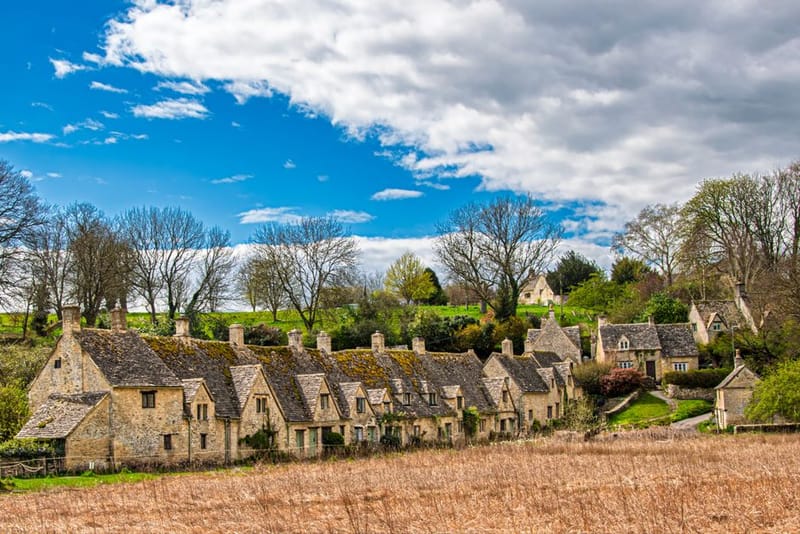
Bibury is a small village on the River Coln, famous for Arlington Row (a National Trust-owned terrace of 14th-century weavers' cottages, the most-photographed scene in the Cotswolds). It is quieter than Bourton + Stow + Chipping Campden and better suited to dogs that find crowded village centres stressful.
Canonical dog-friendly pub: The Catherine Wheel (Arlington Lane, ~6 minutes' walk from Arlington Row; dogs welcomed in the bar + garden + dining room).
Best walk from the village centre: the 2.5-mile circular along the Coln to Ablington and back. Pick up the footpath at the trout farm (north of the village), follow the river west to Ablington (another tiny village with a Norman church), return via the field path. Level walking, river access for paddling, often near-empty even in high season.
Parking: pay-and-display at the village hall (£2 for 3 hours; cash only).
Best for: photographers + dog owners who want classic Cotswold scenery without the village-centre crowds of Bourton. Arrive before 9am for Arlington Row photographs without other tourists in the frame.
Why is Chipping Campden the best for serious hill walking?
Northern Cotswolds + Hidcote Manor gardens
Chipping Campden sits at the northern end of the Cotswold Way (Bath is the southern end, 102 miles away). The village high street is a mile-long honey-stone parade ending at the medieval Market Hall. The combination of Cotswold Way access + the National Trust's Hidcote Manor Garden three miles away makes Chipping Campden the strongest pick for serious dog walkers.
Canonical dog-friendly pub: The Eight Bells Inn (Church Street, just off the high street; dogs welcomed in the bar + most of the dining room + the courtyard).
Best walk from the village centre: the 4-mile out-and-back to Dover's Hill (a National Trust viewpoint at 745ft with views across the Vale of Evesham). Pick up the Cotswold Way at the north end of the high street, climb gently for 30 minutes, return via the same path. Open-access land at the top; lead during ground-nesting bird season (April through July).
Hidcote Manor Garden: NT-owned, dogs welcomed on lead in the gardens + orchards. £15 adult entry, free for NT members. Parking on-site.
Parking: pay-and-display in the high-street car park (£2 for 4 hours) or free on-street north of the village.
Best for: working breeds + active retrievers + walking-holiday parties. Chipping Campden is also the start (or end) of the Cotswold Way thru-hike, popular with overnight walking parties.
Why is Painswick the best Cotswolds village for the Beacon viewpoint?
The Queen of the Cotswolds + the Painswick Rococo Garden
Painswick sits on a hillside above the Slad Valley in Gloucestershire, with the medieval St Mary's Church + 99 yew trees at its centre. It is the best southern-Cotswolds base for serious viewpoint walks.
Canonical dog-friendly pub: The Falcon Hotel (in the village centre; dogs welcomed in the bar + garden + dining room).
Best walk from the village centre: the 3-mile circular to Painswick Beacon and back. Walk north from the village, climb to the Beacon (a 283m hill with an iron age fort + 360-degree views including the Severn Estuary on clear days), descend via the golf-course path. Lead through the golf-course section; otherwise off-lead is generally fine. About 1.5 hours.
Parking: small free car park at the village hall (limited capacity; arrive early) or the larger pay-and-display below the Falcon (£2 for 3 hours).
Best for: photographers + walkers who want big southern-Cotswold views. Painswick is also a useful base for the Slad Valley (Laurie Lee country) + the broader Stroud area.
Why is Castle Combe the best Cotswolds village for postcard-village atmosphere?
Wiltshire's chocolate-box village + the By Brook
Castle Combe sits in a steep valley in Wiltshire, on the By Brook, and is often filmed for period-drama productions (Stardust, Wolf Man, the Tom Cruise War of the Worlds). It is small + quiet + has restrictions on visitor parking inside the village itself (parking is at the top of the hill and you walk down).
Canonical dog-friendly pub: The White Hart (in the village centre; dogs welcomed in the bar + small garden + most of the dining room).
Best walk from the village centre: the 2-mile circular along the By Brook. Walk south through the village, follow the brook west to the old packhorse bridge, return via the field path north of the village. Level + shaded + good for older dogs that prefer flat walking.
Parking: the visitor car park at the top of the village (£4 all-day). The walk down to the village is 5 minutes; the walk back up is 10. There is no village-centre parking for non-residents.
Best for: dog owners who want postcard-village charm + a short walk + a quiet pub lunch, without the Bourton crowds. Avoid weekend afternoons in summer; the village fills up fast.
Why is Tetbury the best Cotswolds village for Westonbirt Arboretum access?
Royal-Cotswolds + the National Arboretum 3 miles south
Tetbury is a small market town in southern Gloucestershire, known for the Royal Highgrove Estate (just north of the town) + the Westonbirt Arboretum three miles south. Tetbury itself is a working market town more than a village (population around 5,500), which makes it less crowded than the honeypot villages and more useful as a holiday base.
Canonical dog-friendly pub: The Snooty Fox (in the Market Square; dogs welcomed in the bar + garden + dining room).
Best walk from the village centre: drive 3 miles south to the Westonbirt Arboretum (NT-owned, dogs welcomed on lead across all 600 acres including the Old Arboretum + Silk Wood). The Silk Wood section has 17 miles of paths through woodland with seasonal colour changes; the Old Arboretum has the famous Japanese maples (best in late October to mid-November). £14 adult entry, free for NT members.
Parking: Tetbury has multiple short-stay car parks; the most useful is the Old Hospital car park (free for 2 hours). Westonbirt has dedicated on-site parking.
Best for: woodland walkers + autumn-colour photographers + holiday parties wanting a town base with shops + restaurants alongside the rural walks.
What is Cotswolds pub etiquette for dog owners?
What to do (and what not to do) at the bar
The pub list above all welcome dogs, but the published pub etiquette applies particularly in the Cotswolds:
Confirm the dog policy before walking in: most Cotswold pubs are dog-friendly, but specific room policies vary. Some welcome dogs in the bar but not the dining room; others welcome dogs everywhere except the breakfast room. Ask at the door rather than walk in and be turned around.
Bring a settle mat or rug: most Cotswold pubs have flagstone floors that get cold for the dog in winter. A small lightweight mat (microfibre yoga-style is ideal) keeps the dog comfortable + signals to the publican that you're a considerate visitor.
Order at the bar, not from the table: dog-friendly pubs are typically gastropubs but with bar-led service. You order food + drinks at the bar with the dog under the table; food is brought out. This is faster than table service + means the dog stays settled.
Tip the staff if they offer dog treats: many Cotswold pubs keep a jar of dog biscuits at the bar. Decline if your dog has dietary restrictions; otherwise tip £1 to £2 extra to acknowledge the gesture.
How to plan a Cotswolds dog-friendly weekend
Two-night itinerary using two of the villages as bases
The most efficient way to see the Cotswolds with a dog is a two-base weekend: one base in the northern Cotswolds (Stow + Chipping Campden) and one in the southern Cotswolds (Painswick + Tetbury). The two halves are about 40 minutes' drive apart on the A429.
Friday night: arrive at the northern base. Dinner at The Porch House (Stow) or The Eight Bells (Chipping Campden). Both have dog-welcoming rooms above the pub.
Saturday morning: Cotswold Way walk from Chipping Campden to Dover's Hill (4 miles return). Lunch back in Chipping Campden.
Saturday afternoon: drive south to the second base (about 1.5 hours via Cirencester). En route, stop at Bibury for the Arlington Row + Coln walk.
Saturday night: dinner at The Falcon (Painswick) or The Snooty Fox (Tetbury). Both have dog-friendly rooms.
Sunday morning: Westonbirt Arboretum (if Tetbury base) or Painswick Beacon (if Painswick base). Lunch en route home.
Pair this with our UK pubs guide for restaurant choices + our car-harness comparison for the drives between bases.