Dogs on London Transport: TfL, Tube & Taxi Rules 2026
TfL allows dogs free on Tube, Overground, DLR, buses and trams - but you must carry them on escalators. Cabs and Uber are driver-discretion.
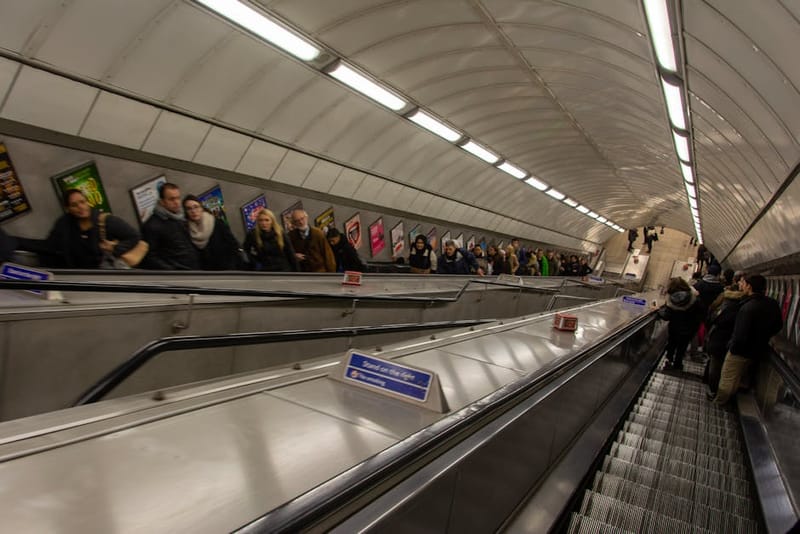
London is one of the more dog-friendly capital cities for public transport - Transport for London accepts dogs free of charge across the Tube, Overground, DLR, Elizabeth line, buses, and trams. The one rule that trips up newcomers (and visiting Londoners) is the escalator rule: dogs must be carried, full stop. This guide covers the full TfL policy plus the separate rules for black cabs, Uber, Addison Lee, and other private hire vehicles. It pairs with our companion UK trains guide for trips that combine London transport with a National Rail journey.
What does TfL allow on the Tube and Overground?
The brand-wide rules across every TfL service
Per TfL's published Conditions of Carriage, dogs and other inoffensive animals are welcome on every TfL service free of charge - provided they're kept under control on a lead or in a suitable container, and never on seats. The policy applies uniformly across:
- London Underground (the Tube - all 11 lines).
- London Overground (all 6 lines).
- Docklands Light Railway (DLR).
- Elizabeth line.
- London buses (one dog per bus, at driver discretion).
- London Trams (Croydon area).
- River services (TfL Riverbus / Uber Boat by Thames Clippers - check operator-specific rules).
There's no booking required, no separate ticket for a dog, and no peak-hour prohibition published at the policy level. The driver / staff retain the right to refuse a dog if there's a specific reason (extreme overcrowding, aggressive behaviour), but this is rare in practice and applies to all passengers proportionally.
The escalator rule - the one rule everyone misses
Why this matters and what to do if your dog is too big to carry
Dogs must be carried on escalators on the TfL network (except registered assistance dogs). This is the most often-overlooked TfL rule, and the one that catches first-time visitors to London out. TfL display 'Dogs must be carried' signage at every Tube station entrance with an escalator, but it's still routinely missed.
The reason is safety: an unattended dog on an escalator step risks claws, fur, or a lead getting caught in the comb-plate at the top or bottom of the escalator - both for the dog and for adjacent passengers. Several incidents over the years have led to the rule being strict and station-staff-enforced.
For large dogs you can't carry: if you have a large dog and physically can't lift them onto an escalator, ask a member of station staff. Outside peak times, staff can stop the escalator briefly to let you walk the dog up or down. This is not a guaranteed service - it depends on staff availability and how busy the station is - so plan around it.
The practical workaround for big dogs: use stations with a lift (most newer or refurbished stations have step-free access; check TfL's step-free access list when planning a route with a large dog). Stations with stairs only (no escalator) are also fine - your dog walks on the lead.
TfL - UNDERGROUND
London Underground (the Tube)
All 11 lines, all stations
- Cost Free
- Lead or carrier Either
- On seats Not allowed
- Escalators Must be carried
TfL - OVERGROUND
London Overground + DLR + Elizabeth line
The 'orbital' London services + recent additions
- Cost Free
- Lead or carrier Either
- Step-free Most stations
- Off-peak best After 09:30 weekdays
TfL - BUSES
London buses
Single-deck + double-deck routes across all 9 zones
- Cost Free
- On lead Required
- Driver discretion May refuse
- Max dogs per bus 1 typically
TfL - TRAMS
London Trams (Croydon)
South London tram network
- Cost Free
- Lead or carrier Either
- Level boarding Step-free
- On seats Not allowed
Are dogs allowed in black cabs (Hackney carriages)?
Driver discretion, not a legal right
Traditional London black cabs (Hackney carriages) are not legally obliged to carry pet dogs, except for registered assistance dogs (guide dogs, hearing dogs, medical assistance dogs) under the Equality Act 2010. For a non-assistance dog, acceptance is at the driver's discretion.
In practice, many black cab drivers do accept dogs - particularly well-behaved smaller dogs and dogs in carriers. The realistic flow:
- Hailing in the street: hold up your hand, and if the driver pulls over, ask politely whether they accept dogs. If yes, get in; if no, wave them on and try the next one. Don't take it personally - drivers vary in their willingness, and a busy day on the rank may shift the answer.
- Black cab apps: Gett is the main black cab app and lets you add a note about a dog at booking. The booking flow surfaces drivers willing to accept the trip - much more reliable than street-hailing.
- Carrier vs lead: a dog in a soft-sided carrier is much more likely to be accepted than a loose dog on a lead. Boot-only access (passenger compartment off-limits) is sometimes the offered compromise on larger dogs.
Are dogs allowed in Uber and private hire vehicles?
Same legal baseline as black cabs, different app-level options
Uber and other private hire vehicles (PHVs) - Bolt, FREENOW, Addison Lee - follow the same legal baseline as black cabs: assistance dogs must be accepted under the Equality Act 2010; everything else is at the driver's discretion.
- Uber: Standard UberX bookings are driver-discretion for pet dogs. The Uber app doesn't require you to disclose a dog at booking, so the practical flow is to message the driver as soon as the ride is assigned - give them the chance to accept or cancel before they arrive. The 'Uber Pet' product (slightly higher fare, drivers opt in to accepting pets) is available in some UK cities but London availability has been inconsistent - check the app at the time you're booking.
- Bolt + FREENOW: Similar driver-discretion model. Message the assigned driver promptly.
- Addison Lee: Has a dedicated pet-friendly booking option in the app - request a driver who will accept your dog. This is the most reliable PHV route in London for non-assistance dogs.
For assistance dogs, every PHV driver is legally required to accept the booking and provide a free ride (the dog travels free, the human pays the standard fare). Drivers who refuse can be reported to the operator and to TfL for licensing review.
What practical tips help when travelling London with a dog?
Travel off-peak where possible. The Tube outside 07:30–09:30 and 17:00–19:00 weekdays is far more comfortable with a dog at-foot.
Bring water + a collapsible bowl. Tube stations get warm in summer (the Central line in particular hits 30°C+) and there are no dog water points.
Use stations with step-free access. Check TfL's accessibility map before planning a route - it skips the escalator-carry problem for large dogs.
Carrier for small dogs is easier than lead. A soft-sided carrier within a normal bag size lets you skip the escalator-carry decision and is accepted by every PHV driver.
Toilet breaks before the Tube. Major termini (King's Cross, Paddington, Victoria, Waterloo) have outdoor spaces - get a pre-journey break in. There are no in-Tube toilet options for dogs.
Avoid escalator-only stations with big dogs. Some Tube stations have only escalator access - Bank, Holborn, Tottenham Court Road. Plan a route that uses step-free or stair-only stations instead.
Frequently asked questions
Can I take my dog on the London Underground?
Are dogs free on TfL?
Can I carry my dog on the Tube escalator?
Are black cabs in London dog-friendly?
Does Uber accept dogs in London?
Are dogs allowed on London buses?
How do I avoid escalators on the Tube with a large dog?
Pet-Friendly Trains UK
Best UK Pet-Friendly Hotel Chains

Travelodge Pet-Friendly Review