Taking Your Dog to Ireland: 2026 UK Guide
How to take a dog from the UK to Ireland: the Animal Health Certificate, rabies and tapeworm rules, ferry routes, pet cabins and Northern Ireland.
Taking your dog to Ireland is wonderfully doable, but since Brexit the paperwork has changed and the old pet passport no longer works. The Republic of Ireland is in the EU, so your dog needs an Animal Health Certificate, an up-to-date rabies vaccination and a vet-administered tapeworm treatment, all timed carefully around your travel date. The journey itself is by ferry across the Irish Sea, where dogs travel free in pet cabins or kennels. Get the timings right and it is a smooth trip. This guide walks through exactly what you need and how to plan it.
Can you take a dog to Ireland from the UK?
Yes, and many people do every year. The practical route is by ferry across the Irish Sea, since the airlines flying between Britain and Ireland do not carry pet dogs in the cabin or hold except registered assistance dogs. The good news is that dogs travel free on the Irish Sea ferries, so the main job is getting the paperwork and timings right.
Because the Republic of Ireland is part of the EU, your dog is treated as entering the EU and must meet the EU pet entry rules. These are set out by the UK government on its taking your pet abroad pages, which are the authoritative source to check before every trip. Northern Ireland, as part of the UK, has its own simpler arrangement, covered further down.
What do you need to take a dog to Ireland?
Four things have to be in place, and the order and timing matter. Start planning at least three to four weeks ahead, because the rabies rule alone requires a three-week wait.
A microchip
Your dog must be microchipped, which is already a legal requirement for dogs in Great Britain. The chip must be in place before the rabies vaccination for it to count.
A rabies vaccination
Your dog needs a valid rabies vaccination, given after the microchip. You must then wait at least 21 days after the vaccination date before travelling. If a previous vaccination has lapsed, you start the 21-day clock again.
An Animal Health Certificate (AHC)
An Official Veterinarian must issue an AHC within 10 days of your travel date. It replaces the old pet passport, is valid for 10 days for entry, and then allows travel within the EU for four months. You need a new AHC for each separate trip.
A tapeworm treatment
Because Ireland is tapeworm-controlled, a vet must treat your dog for tapeworm with a praziquantel product between 24 and 120 hours (1 to 5 days) before your scheduled arrival in Ireland, and record it. Miss this window and your dog can be refused entry.
How do you get to Ireland with a dog?
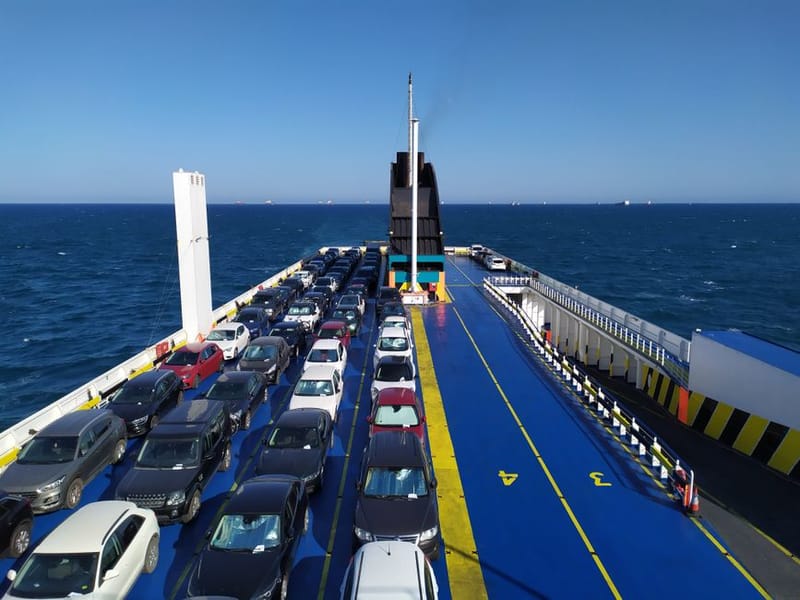
The crossing is by ferry, and there is a good choice of routes depending on where you start. The main Irish Sea car-ferry routes that carry pets are:
- Holyhead to Dublin, the busiest and fastest of the main routes, run by Stena Line and Irish Ferries.
- Fishguard to Rosslare and Pembroke to Rosslare, handy for the south and west of Ireland.
- Liverpool to Dublin, a longer overnight option from the north of England.
- Cairnryan to Belfast, the quick route from Scotland into Northern Ireland.
Dogs travel free on these routes, but you must book their space in advance, as pet cabins and kennels are limited and fill quickly in summer.
Pet cabins and kennels on the ferry
How your dog travels depends on the operator and route, and it is worth choosing deliberately:
- Pet-friendly cabins let your dog stay with you for the whole crossing. Stena Line offers them on its Liverpool, Holyhead and Fishguard routes, with vinyl floors, water bottles and pee pads, and Irish Ferries has a dedicated Pet Den plus pet cabins on its Dublin to Holyhead ship. These sell out fast, so book early.
- Onboard kennels are free on several routes, including Cairnryan to Belfast, Holyhead to Dublin and Fishguard to Rosslare. Your dog travels in a kennel on the car deck or a pet area, and kennels must be pre-booked.
- Staying in the vehicle is allowed on some crossings, but not all, and is less comfortable for the dog. Check your operator's policy when booking.
A maximum of two pets per cabin usually applies, with any extras going in kennels or the vehicle. Whichever you choose, bring water, a familiar blanket and a lead for boarding and disembarking.
What about taking a dog to Northern Ireland?
Northern Ireland is part of the UK, so the rules are far simpler. For travel from Great Britain to Northern Ireland only, you do not need a rabies vaccination, an Animal Health Certificate or a tapeworm treatment. Under the current arrangement you travel with a Pet Travel Document, and the Northern Ireland authorities set out the detail.
The important catch is onward travel. If you plan to cross from Northern Ireland into the Republic of Ireland, your dog is then entering the EU, and the full requirements apply: a valid rabies vaccination, an Animal Health Certificate and a tapeworm treatment. There is no border check on the island, but the legal requirement still stands, so plan as though you are going to the Republic if there is any chance you will cross.
What do you need to bring your dog back to the UK?
Coming home is more straightforward. To return to Great Britain from Ireland your dog needs its microchip, a valid rabies vaccination and either the same Animal Health Certificate, which covers the return leg within its four-month window, or a pet travel document issued in the EU.
Helpfully, you do not need a tapeworm treatment to bring a dog back into Great Britain from Ireland, as Ireland is one of the few countries exempt from the GB tapeworm rule. As always, check the current GOV.UK guidance before you travel home, as the rules are reviewed periodically.
Frequently asked questions
Can I take my dog to Ireland on a pet passport?
How long before travelling to Ireland do I need to prepare?
Do dogs need a tapeworm treatment for Ireland?
Can dogs fly to Ireland from the UK?
Do I need a tapeworm treatment to bring my dog back to the UK?
Dog Travel UK to France: Ferry vs Le Shuttle

Dartmouth Ferry Dog Policy
Dog-Friendly UK Road Trip Planner