Affiliate disclosure
We may earn a commission when you buy through links on our site, at no extra cost to you. Our editorial opinions are our own and are not influenced by compensation.
Comparison · 5 picks
Best Dog Travel Crate UK: 5 Picks for Car and Air
A travel crate isn't just a box on wheels - it's the difference between your dog arriving safely and a £200 vet bill (or worse) after a sudden stop. UK pet owners face two distinct crate problems: keeping a dog secure in the car, and meeting IATA standards for flying. The right answer is rarely the same crate for both. This guide compares the five strongest options in 2026 across crash testing, IATA compliance, weight, ventilation and price.
Recommendations are based on published manufacturer specifications, IATA Live Animals Regulations, third-party crash-test results where available, and aggregated UK customer-review patterns from major retailers. Affiliate disclosure: this page contains affiliate links to UK retailers - we may earn a small commission if you buy through them, at no extra cost to you. Specific affiliate links below are placeholders pending replacement; the recommendations don't change based on which retailer pays.
At a glance
All 5 options side by side.
| MIM Variocage Double | Petmate Sky Kennel | Rosewood Options Soft Crate | Impact Dog Crates Stationary | Ferplast Atlas Professional | |
|---|---|---|---|---|---|
| Best for | - | - | - | - | - |
| Use case | Car only | Air (cargo) | Indoor / destination | Car + air | Air (cargo) + indoor |
| Crash tested | Yes (MSP) | No | No | Anecdotal | No |
| IATA approved | No | With metal fasteners | No | Some sizes | Some sizes (with metal hardware) |
| Material | Steel | Plastic | Fabric | Aluminium | Plastic |
| Foldable | No | No | Yes (flat) | No | No |
The picks in detail
MIM Variocage Double
Pros
- Independently crash-tested to demanding Swedish MSP standard - among the strongest options for car safety
- Steel construction with crumple zones designed to absorb energy in a collision rather than transfer it to the dog
- Modular sizing - adjusts to the boot dimensions of most UK estates and SUVs without permanent installation
- Twin-compartment versions allow two dogs to travel separately on a single base
Cons
- Premium price point - significantly more expensive than mainstream plastic crates
- Heavy and not designed for lifting in and out daily - best suited to vehicles where it can stay installed
- Not airline-approved as cabin or hold equipment - purely a vehicle crate
- Sizing requires careful measurement; returns can be inconvenient if you order the wrong size
Petmate Sky Kennel
Pros
- IATA-compliant when fitted with metal fasteners - accepted by most UK and European airlines for cargo travel
- Wide size range from XS through Giant, covering breeds from Yorkshire Terriers to Great Danes
- Solid plastic shell with ventilation on all four sides meets airline ventilation requirements
- Widely available from UK retailers - easy to source and replace parts
Cons
- Default plastic clips do NOT meet IATA specifications - you must replace with metal hardware before flying
- Not crash-tested for car use - fine as a stationary crate but offers no certified collision protection
- Plastic shell is heavier and less ventilated than wire or aluminium alternatives in warm weather
- Bulky to store when not in use - no fold-flat option
Rosewood Options Soft Crate
Pros
- Lightweight nylon and mesh fabric folds flat for storage - easiest of the five to transport when empty
- Inexpensive - typically the cheapest option per litre of internal volume
- Fast to assemble at destination - useful for caravan, cottage and hotel stays
- Mesh sides allow good airflow on warm days, reducing heat-stress risk
Cons
- NOT suitable for unsupervised or anxious dogs - fabric tears easily under sustained chewing
- Provides no crash protection in vehicles - should not be used as a primary car restraint
- Not airline-approved - IATA requires rigid construction for hold transport
- Less durable than rigid alternatives; expect a 1-3 year working life with regular use
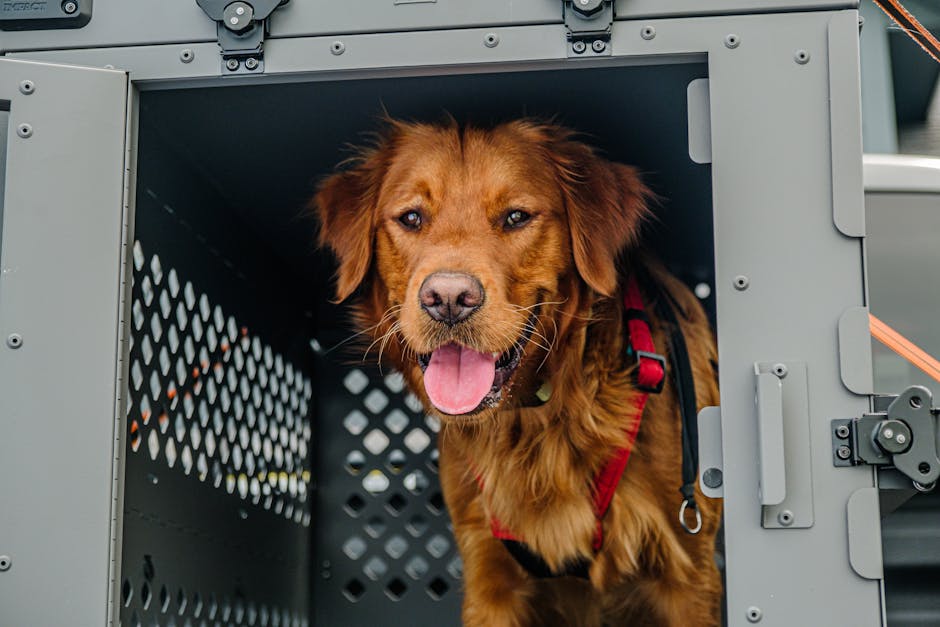
Impact Dog Crates Stationary
Pros
- Aircraft-grade aluminium construction - significantly lighter than steel while remaining chew-proof for most dogs
- Some sizes meet IATA cargo specifications for major airlines (verify the specific model and airline before booking)
- Lifetime warranty on the frame from the manufacturer
- Strong reputation for surviving collisions and escape attempts that destroy cheaper crates
Cons
- Highest price point in this list - typically 2-3x the cost of a Petmate Sky Kennel
- Long lead times when shipping from US - UK availability via specialist retailers is limited
- Solid sides reduce visibility, which can make some dogs more anxious during transport
- Heavy enough that two-person lifting is recommended for the larger sizes
Ferplast Atlas Professional
Pros
- Italian-made plastic crate available with IATA-spec hardware option for the larger sizes
- Wider range of in-stock UK retailers than US-imported alternatives - easier same-week purchase
- Mid-range pricing that sits between budget Petmate options and premium aluminium crates
- Top half can be removed on some models for easier loading of older or less mobile dogs
Cons
- Not all sizes are airline-approved - must verify the specific model number against airline requirements
- No crash-test certification for car use
- Plastic clips on standard models need to be replaced with metal hardware for flights
- Construction quality is variable across batches per UK reviews - inspect carefully on arrival
Should I buy one crate for car and flight or two?
Why a flight crate and a car crate often need to be different products
The single most useful thing to understand before buying a travel crate is that car safety and IATA compliance are different requirements with very little overlap.
Car safety is about crash energy. In a 30 mph frontal collision, a 25 kg dog in an unrestrained crate effectively becomes a 1,250 kg projectile (the standard rule of thumb is mass × deceleration in g-forces). A crate that survives a stationary chew-proofing test is not the same as a crate that survives a collision. Independent UK car-travel testing typically references the Swedish MSP standard or the German TÜV standard - MIM Variocage is the most widely cited example.
IATA compliance is about a list of structural and ventilation requirements (the Live Animals Regulations / Container Requirement 1) that must be met before any airline will load a dog in cargo. Critical features: rigid construction with no folding parts, ventilation on all four sides, leak-proof bottom, food and water dishes accessible from outside, and metal hardware (not plastic clips) at every join. Crates that meet IATA may not meet crash standards, and vice versa.
If your dog only flies once or twice a year, you'll probably want one cheap IATA-spec crate for flights and a second crash-tested crate for daily car use. The exception is high-end aluminium crates like Impact, which can plausibly cover both jobs in a single (more expensive) purchase.
What makes a crate crash-safe in the car?
What "crash tested" actually means - and why most crates aren't
Independent UK consumer testing - including the Centre for Pet Safety in the US, which has the most rigorous published methodology - has repeatedly shown that the majority of pet crates and harnesses fail at typical motorway crash speeds. Plastic crates split. Wire crates collapse. Soft crates disintegrate. Even some advertised "crash tested" products have failed when tested by independent labs.
The Variocage range is the most consistent performer in published testing because it's designed for the problem from the start: steel construction, deliberate crumple zones, and a base that bolts or clamps to the vehicle so the crate doesn't move during impact. Impact Dog Crates have a strong anecdotal track record but less published independent testing. Both are significantly more expensive than mainstream plastic crates, and that price gap reflects engineering rather than marketing.
If a crash-rated crate is out of budget, a properly-fitted crash-tested harness is the next-best option for car travel - see our best dog car harness comparison for crash-tested choices that work without a crate.
What does IATA actually require for flying with a dog?
The seven rules every cargo crate must meet, and the easy ways to fail
For UK owners flying with a dog in cargo, IATA Container Requirement 1 sets the baseline. Most major airlines (BA, KLM, Lufthansa, United, Delta) require it. The seven things a cargo crate must have:
- Rigid construction - no fold-flat designs, soft sides or fabric components.
- Ventilation on at least four sides (front and three other sides), with a minimum total ventilation area specified by airline.
- Metal hardware at every door fastening - plastic clips and zip ties are explicitly disallowed.
- Door with a centralised locking system that engages multiple points.
- Leak-proof bottom - typically achieved with absorbent bedding plus a solid plastic floor.
- External food and water dishes that can be filled by ground crew without opening the crate.
- Sufficient internal space for the dog to stand fully upright, turn around comfortably and lie naturally - most refusals at the gate are for crates that are slightly too small.
The Petmate Sky Kennel is the most common reasonably-priced choice for UK owners - but only when fitted with the official metal fastener kit. Buying the crate alone without the metal hardware is the most common reason a crate is rejected at check-in. Read our UK flying with a dog guide for airline-specific rules and pre-flight paperwork.
How do I size a travel crate correctly?
The rule that catches most first-time buyers
The IATA sizing rule, simplified: measure your dog's length from nose to base of tail (A), height from floor to top of head while standing (B), and width across the shoulders (C). The crate must be at least A+½B long, B+5cm tall, and 2C wide. For most medium dogs this puts you one size larger than retailer charts suggest - particularly for tall, lean breeds (Greyhounds, Whippets, Vizslas).
For car crates the rule is reversed: you generally want the crate slightly smaller than the IATA minimum so the dog can't be thrown around inside it during a collision. A snug-fitting MIM Variocage holds the dog more securely than a larger one. This is one of the genuine reasons two crates often beats one.
Recommendation matrix
Map your situation to the right pick in 60 seconds
Daily car travel, safety-conscious owner, budget over £500: MIM Variocage Double. The clearest crash-test record at this price point and the most widely respected option among UK working-dog owners.
Occasional flights, doesn't fly often enough to justify premium: Petmate Sky Kennel with the metal fastener upgrade. Cheapest reliable IATA-compliant option in the UK market.
Wants one crate that does both car and air well: Impact Dog Crates Stationary. Expensive, long lead times, but the most credible single-crate solution.
Indoor / destination crate only - never primary car restraint: Rosewood Options Soft Crate. Cheap, foldable, ventilated, but only for trained, supervised dogs.
Mid-range air-travel option, prefers UK availability over US import: Ferplast Atlas Professional. Verify the specific model meets IATA spec and budget for the metal hardware upgrade.
Multiple dogs travelling together: MIM Variocage twin-compartment for the car; two separate IATA-spec crates for the hold (airlines do not accept double-compartment crates for cargo travel).
Which UK departure airlines allow dogs in cabin or cargo in 2026?
BA, Virgin Atlantic, KLM, Lufthansa, and the AVI / IATA policy split
What documentation do I need to fly a dog from a UK airport in 2026?
GB Pet Travel Document, rabies vaccination, microchip, and destination-specific extras
Frequently asked questions
Q01Can I use the same crate for car travel and flying?
Q02Are plastic crates safe in a car crash?
Q03Why does the IATA rule require metal hardware?
Q04How long before a flight should I get the dog used to the crate?
Q05Can I check the crate as luggage and transport the dog separately?
Q06What about wire crates - are any safe in a car?
Affiliate disclosure: this comparison contains affiliate links to UK retailers. We may earn a small commission if you buy a crate through one of our links, at no additional cost to you. Pricing shown is a typical UK street price at the time of writing - verify current pricing on the retailer's site before purchase, as it changes frequently.