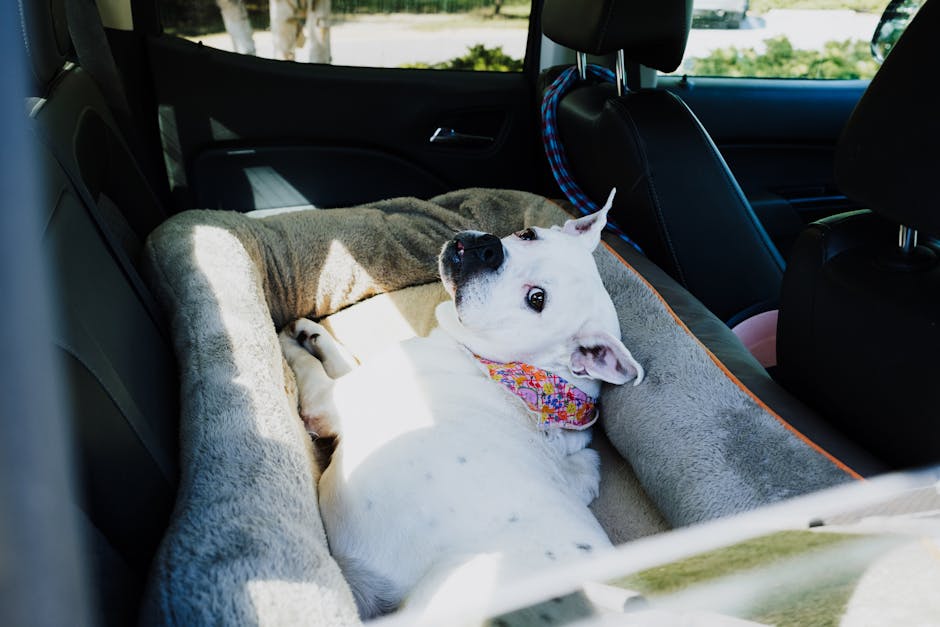
Travelling With an Anxious Dog: A UK Owner's Guide
Calming, carsick, or crate-shy? A research-backed UK guide to anxiety vs sickness, vet-approved options, and how to build car confidence step by step.
Travel-anxious dogs are far more common than the cheerful Instagram road-trip footage suggests, and the conventional advice — "just take them on more car journeys" — is exactly the wrong approach for a dog whose nervous system has already learned that the car means a vet, a kennel, or a thirty-minute panting session ending in a vomit. This UK-focused guide pulls together what the veterinary literature, behavioural science, and the front-of-house experience of British boarders, ferry operators, and rail companies suggests works for genuinely anxious dogs. It also calls out the popular advice that doesn't, and the cases where the right next step is a vet appointment rather than another behavioural session.
Anxious or carsick? Three signals to tell them apart
The two conditions look superficially similar — drooling, restlessness, vocalising, refusal to eat — but the underlying mechanism is different, and the right response depends on which you're actually dealing with.
Travel anxiety is a learned behavioural response. Symptoms typically appear before the engine starts: pacing at the front door, refusing to approach the car, trembling when the keys come out. The dog's discomfort is anticipatory. The cure is behavioural — counter-conditioning the cue stack from negative to neutral or positive.
Motion sickness is a vestibular response — the inner ear and the eyes report different motion to the brain, and nausea follows. Symptoms appear during the journey, often within five to fifteen minutes of moving, and worsen with twisting roads. Puppies under a year are dramatically over-represented because the vestibular apparatus matures with age. The cure is medical — anti-nausea medication from a vet (typically maropitant, brand name Cerenia) plus journey-management changes.
Crate or confinement anxiety sits between the two. The dog is fine in a moving car but distressed when restrained. Symptoms peak when the harness clips or the crate door closes, not when motion starts. The cure is gradual desensitisation to the restraint itself, separately from the journey.
Telling the three apart matters because the wrong intervention reinforces the wrong loop: medicating an anxious dog who isn't actually nauseous teaches the dog that car journeys feel weird (drowsy + still scary) without resolving the anxiety. Behavioural training a genuinely carsick dog asks them to learn while they feel ill, which they cannot do.
Why training matters more than tablets for most cases
For dogs whose primary issue is anxiety rather than sickness, behavioural conditioning has substantially better long-term outcomes than pharmacological intervention alone. The reason is straightforward: medications dampen the physiological response (heart rate, panting, drooling) without changing what the dog has learned about car journeys. Stop the meds and the underlying association reasserts itself.
Counter-conditioning works the other direction. The aim is to break apart the cue stack that triggers anxiety — sight of the car, sound of the engine, motion, destination — and rebuild each component as either neutral or positively associated. The work is slow (most owners need four to eight weeks of consistent short sessions for a meaningful change) but the change is durable.
The combination — short course of medication during the rebuild phase, behavioural work as the primary intervention — is the approach most behavioural vets recommend. The medication is a scaffold, not the building.
The seven-step car-confidence build
Decouple the car from the destination
For one week, the only car interaction is sitting in the driveway with the engine off, doors open, treats inside. No journey. The dog learns that the car can be a non-event.
Add the engine without motion
Engine on for thirty seconds, treats throughout, engine off, walk away. Repeat daily for a week. The engine sound becomes part of the food-reward routine, not the journey-cue.
First short journey ends somewhere good
Three minutes of driving to somewhere the dog enjoys — a quiet park, a friend's garden, a calm walk. Critically not the vet, kennel, or grooming parlour. Repeat for two weeks.
Extend gradually with the same destination type
Add five minutes per week to the journey length, but keep the destination positive. The dog's expectation builds toward 'good things at the end of the car ride'.
Introduce the harness or crate as a separate process
Crate or harness desensitisation runs in parallel at home — short sessions of clipping the harness on for a treat, harness off, end. The dog is not in the car for this.
Combine harness and journey only once both are calm independently
Once the dog is calm in the car for ten-minute trips and calm in the harness for ten minutes at home, combine the two. Start with three-minute journeys and build from there.
Generalise to less-favoured destinations
Once long positive-destination journeys are calm, gradually add neutral destinations (a quick errand stop) and only then the unavoidable negative ones (vet, kennel). The ratio should remain heavily positive.
Calming options that have actual evidence behind them
The pet-shop shelves carry dozens of calming products for dogs and the evidence base behind them ranges from "published RCT" to "vibes". Here's what the research actually supports for travel anxiety, with the asterisks where they belong.
Adaptil (DAP, dog-appeasing pheromone). A synthetic version of the pheromone produced by nursing bitches. Multiple peer-reviewed studies show modest reduction in anxiety markers in stressful situations, including travel. Comes as a spray, collar, or plug-in diffuser. The car spray (Adaptil Travel) is the relevant format here — applied to the car interior 15 minutes before the journey. Effect is modest but real. Available widely in UK at Pets at Home, Jollyes, and online.
Pet Remedy. A blend of valerian and other plant extracts. Less rigorous evidence base than Adaptil — most studies are vendor-funded — but anecdotal reports are positive and there's no plausible safety concern.
ThunderShirt and equivalents. Pressure vests applying gentle constant pressure across the dog's torso. Mixed evidence — works for some dogs, no measurable effect for others. Worth trialling at home before a journey to see whether your dog is in the responder group.
CBD products. The UK market is essentially unregulated for veterinary products. There is some emerging research suggesting an anxiolytic effect at the right dose, but the right dose, the bioavailability of pet-marketed products, and the quality control are all uncertain. Not the first port of call.
Food rewards as the primary tool. Underrated. The most evidence-backed intervention for travel anxiety is high-value food during journeys — not as a bribe but as a counter-conditioning tool. A LickiMat smeared with peanut butter or pâté, fed in the car at the start of every journey, builds a positive association faster than any pheromone diffuser.
When to ask the vet about medication
Behavioural work is the right primary intervention for most travel-anxious dogs. There are specific situations where medication should be on the table:
Confirmed motion sickness. If the dog is drooling and vomiting during journeys but not anxious before them, the issue is vestibular and behavioural training won't fix it. Maropitant (Cerenia) is a prescription anti-nausea drug specifically licensed in the UK for dog motion sickness. Single tablet given two hours before the journey, lasts ~24 hours. Not a sedative — it doesn't change behaviour, just blocks the nausea pathway.
Severe anxiety blocking training. Some dogs are too anxious for behavioural work to land — the cortisol level during exposure exceeds the threshold at which learning happens. A short course of trazodone or gabapentin under vet supervision can drop the baseline enough that training becomes possible. The medication is the scaffold, not the cure.
One-off unavoidable journeys. Long ferry trip to a holiday destination booked before the anxiety became apparent. The pragmatic answer is a one-off prescription to manage that specific journey, alongside starting the behavioural work for next time.
The medication that does not belong on this list is human sedatives, pet-shop "calming chews" with vague melatonin or chamomile content, or anything not prescribed by a vet who has seen the dog. Sedating a dog with the wrong drug at the wrong dose can cause paradoxical excitement (the dog becomes more anxious because they're disoriented) and is dangerous in motion-sickness cases.
Gear that helps (and what to skip)
Three pieces of car gear genuinely improve outcomes for anxious dogs, and a few categories that don't.
Crash-tested car harness. The legal requirement under the UK Highway Code (Rule 57) is that pets are "suitably restrained" — a clipped harness counts. Beyond legal compliance, a properly fitted harness reduces the dog's available motion in the back seat, which paradoxically tends to reduce anxiety in the same way a well-fitted seatbelt is calming for an anxious human passenger. See our best dog car harness UK comparison for crash-tested options at different price points, and individual reviews of the Ruffwear Load Up, Kurgo Tru-Fit Smart, and Mighty Paw Vehicle Safety Harness.
Crate (for dogs already crate-trained). A crash-tested crate restricts visual stimulation, gives the dog a den-like enclosed space, and is generally calming for anxious dogs. The catch is that a non-crate-trained dog put in a crate for the first time during a journey will be more anxious, not less — the crate must be a positive at home before it becomes a positive in the car. See our best dog travel crate UK comparison.
Window covers. Cheap to buy, modest effect for some dogs. Reduces visual motion stimuli (helpful for vestibular cases) and reduces the dog's awareness of speed. Mesh covers that block visual but not airflow are the category to look at.
Skip: dog-shaped car seats designed to prop the dog up to window level. These prioritise visibility for the human ("my dog can see out!") over the dog's actual welfare; a more visually stimulating environment is the wrong direction for an anxious or carsick dog.
Frequently asked questions
Will my dog grow out of car anxiety?
How long should the seven-step rebuild take?
Can I give my dog Benadryl or human travel sickness tablets?
Is the harness or crate better for an anxious dog?
Do calming treats from the pet shop work?
We have a six-hour drive booked next month — what's the realistic plan?
More UK travel guides
From <a href="/blog/travelling-with-dog-by-car/">car-travel basics</a> to the <a href="/blog/dog-travel-checklist/">complete UK travel checklist</a> and <a href="/blog/travel-with-dog-by-train-uk/">rail travel rules</a>.